
Making Elves Weird Again

For quite some time now, I've been running my games as "humans only", at least when it comes to the available playable races. Generally speaking, I prefer strongly humanocentric settings, and I feel like that aspect of the game world is severely undermined when non-human races (such as Elves, Dwarves, and Orcs) are available as options for player characters.
Too often, playing a non-human race is simply treated as a cosmetic choice, one that is swiftly forgotten about in any case. This topic has already been covered by Bos on his own blog, so I won’t retread this ground. A link to the relevant blogpost is provided below.
https://borderbaronies.bearblog.dev/make-fantastic-races-fantastic-again/
For my part, I have come to the conclusion that if a referee is going to include playable demi-human races in their setting, then playing as one should provide a significantly different gameplay experience.
It shouldn't feel like you're playing a human, with some additional bonuses or restrictions. The player should constantly "be hit over the head" with the fact that they are playing a distinctive, non-human race. It should feel at least "as different" as the differing gameplay experience you get when playing a Fighting-Man, compared to playing a Magic-User.
It shouldn't be a minor, passive thing like "oh, I just remembered I'm a Dwarf, can I make a roll to notice some weak points in the dungeon’s stonework", it should be a full-blown "alien" experience to play as something like that, something that constantly intrudes into the game both mechanically and narratively.
It sounds obstructive, but I feel like this sort of constant intrusion should be held to, even if (in fact, especially if) it's something that could quickly become frustrating or un-fun for the player. Only by such means, can the player be constantly reminded of their character’s inhuman nature. I have often remarked that “subtlety has no place in a tabletop RPG”, and that running a game is comparable in some ways to stage acting, in that the referee has to “act to the back row”, with the aim of making things very clear to the audience (that being the players, in the context of a role-playing game).
To this end, I have recently had some ideas bumping around in my brain for some new interpretations of the various demi-human races. In this post, I’ve written up some rules for playable Elves, taking inspiration from classic fantasy literature (Poul Anderson’s Three Hearts & Three Lions, as well as The Broken Sword), real world mythology and folklore, as well as different concepts from the various editions of D&D.
My intent here is that any referee can read through this list of special rules, and select those that catch their fancy. There is no expectation that all of these rules will be applied together, or indeed, that any of them will be applied at all.
It may very well be the case that the referee uses these rules solely as a source of general inspiration, or as a means to provide some “setting colour”, such as by having the player characters encounter some villagers reciting a local folk tale about shape-shifting creatures that emerge from the woods at night, intent on devouring any human they can find.
Anyway, that’s enough preamble, here’s my rules for Elves.
-
Elves: Elves are available as a playable race. Unless otherwise specified, Elves function as described in the “3 LBB” of Original Dungeons & Dragons, freely switching between the Fighting-Man and Magic-User classes from adventure to adventure.
Any experience points gained by the Elf during an adventure are allocated into the character class that the Elf was playing during that adventure. The character’s advancement as either a Fighting-Man or Magic-User is recorded entirely separately, so that the character may be a “Fighting-Man 3 / Magic-User 2”, for example.
In regards to the character’s to-hit chances, saving throw values, and number of hit die, the Elf uses the values of the class that they are currently playing as. The Elf rerolls their hit points each time they switch class (in addition to re-rolling their hit points after levelling up, as normal).
While wielding a bow, Elves may perform split-move and fire.
Elves have a 2-in-6 chance of automatically detecting any secret door they pass. If an Elf is actively searching for secret doors, their chance of successfully locating them is increased to 4-in-6.
Elves are skilled at moving stealthily through wooded terrain. While moving through this type of terrain, they have a 4-in-6 chance of surprise.
Elves are only surprised on a 1-in-6.
Elves see well in darkness or dim light, but unlike dungeon-dwelling monsters, Elves cannot see in total darkness. Like many nocturnal animals, an Elf’s eyes have a light-reflecting “eyeshine” that is visible in low-light conditions. When Elves are subject to full daylight, they subtract one from their “to hit” and morale rolls.
Elves don’t sleep, instead entering into a strange meditative trance when they need to rest. A full cycle of this trance state takes around four hours, after which they Elf is fully refreshed, as if they’d had a full night of restful sleep. During this trance, the Elf can decide to switch class, as mentioned previously.
Elves are immune to the paralysing touch of Ghouls. This is because Elves are enthusiastic man-eaters, who are also known to devour their own dead.
If an Elf is subject to a Sleep spell, or any kind of magical charm spell, they make their saving throws as if they were a Fighting-Man four levels higher (a sixth-level Elf is equal to a tenth-level Fighting-Man).
Elves have the ability to “Command Wild Beasts” as a Cleric of the same level “Turns Undead” (Men & Magic). On a “Turned” result, any affected creatures will cease any hostile behaviour towards the caster, and act in a neutral or friendly manner towards them. On a “Dispelled / Dissolved” result, any affected creatures instead come under the control of the caster for 1d6 + 6 turns, as if affected by a “Potion of Animal Control” (Monsters & Treasure).
Elves must be Chaotic in alignment. Further, they may be “Turned” by a Lawful Cleric’s “Turn Undead” spell. To determine the success of the Cleric’s Turning attempt, treat the Elf as an Undead creature with the equivalent number of hit die.
Elves are harmed by direct contact with iron and other ferrous metals, receiving one point of damage per round so long as they remain in direct contact with these materials. If an Elf is attacked with a weapon made from ferrous metal, the weapon is treated as a “+ 1” weapon, with this bonus being in addition to any other modifiers normally applied.
Given that Elves cannot wield weapons or armour made from ferrous metal, any metal equipment purchased by the Elf during character creation is assumed to be constructed from elf-steel, a lightweight silvery-white metal that resembles titanium. When purchased by an Elf during initial character creation, use the standard cost for any elf-steel equipment. In the course of actual gameplay however, elf-steel equipment is never available for less than twenty times the standard cost of the item.
Elves can’t be raised from the dead, as they don’t have souls.
For Elves, the use of magic is largely an intuitive internal process. Elves don’t memorise and cast spells like human Magic-Users do. Instead, Elves may only cast spells through the use of Forbidden Blood Sorcery (refer to upcoming post for further details). Elves also practice the magical art of skin-changing (refer to upcoming post for further details).
In addition, Elves do not use the “scholarly” tools of the human Magic-User, such as magic wands, staves, staffs, and spell scrolls. However, Elves freely make use of magic weapons and armour, as well as worn magical items such as rings and amulets. In essence, if it can be used by an ordinary Fighting-Man, the Elf will likely see its use as being acceptable.
Elves don’t use a spellbook like human Magic-Users do. Instead, Elves have a set list of spells that they gradually “unlock” as they level up. Elves begin play with one of the following spells already known, rolling a d10 at character creation to randomly determine their initially known spell.
Elf Spell List:
1 - Charm Person (1st Level Magic-User Spell, Men & Magic)
2 - Commune with Nature (5th Level Druid Spell, Eldritch Wizardry)
3 - Confusion (4th Level Magic-User Spell, Men & Magic)
4 - Dancing Lights (1st Level Magic-User Spell, AD&D Player's Handbook)
5 - Growth of Plants (4th Level Magic-User Spell, Men & Magic)
6 - Hallucinatory Terrain (4th Level Magic-User Spell, Men & Magic)
7 - Invisibility (2nd Level Magic-User Spell, Men & Magic)
8 - Sleep (1st Level Magic-User Spell, Men & Magic)
9 - Speak with Animals (1st Level Cleric Spell, Men & Magic)
10 - Ventriloquism (1st Level Magic-User Spell, Greyhawk)
Upon reaching a new level, the Elf rolls a die to randomly determine the next spell they gain access to. The size of the die being rolled (d10, d8, d6, d4) corresponds to the number of spells that have not yet been “unlocked”. If there are an odd number of spells remaining on the list, just use the most applicable size of die, re-rolling if necessary.
Another way in which an Elf may add new spells to their list of known spells is by devouring the brain of a Magic-User. If the Magic-User in question had any spells memorised at that time, then the Elf may add all of those spells to their own list of known spells. If the memorised spells were cast prior to the brain being eaten, then the spells are not transferred across. In addition, the brain must be uncooked and very fresh when consumed, otherwise the spell transfer will not occur. It is rumoured that some human Magic-Users also engage in this practice.
-
In the context of my own campaign setting, I envisage Elves as originally hailing from an alternate dimension entirely, a mist-shrouded twilight realm of dense forest and rolling green hills. I’ll include an excerpt from Lord Dunsany’s “The King of Elfland's Daughter” here, as I feel it perfectly describes the appearance of my own imagined Elfland.
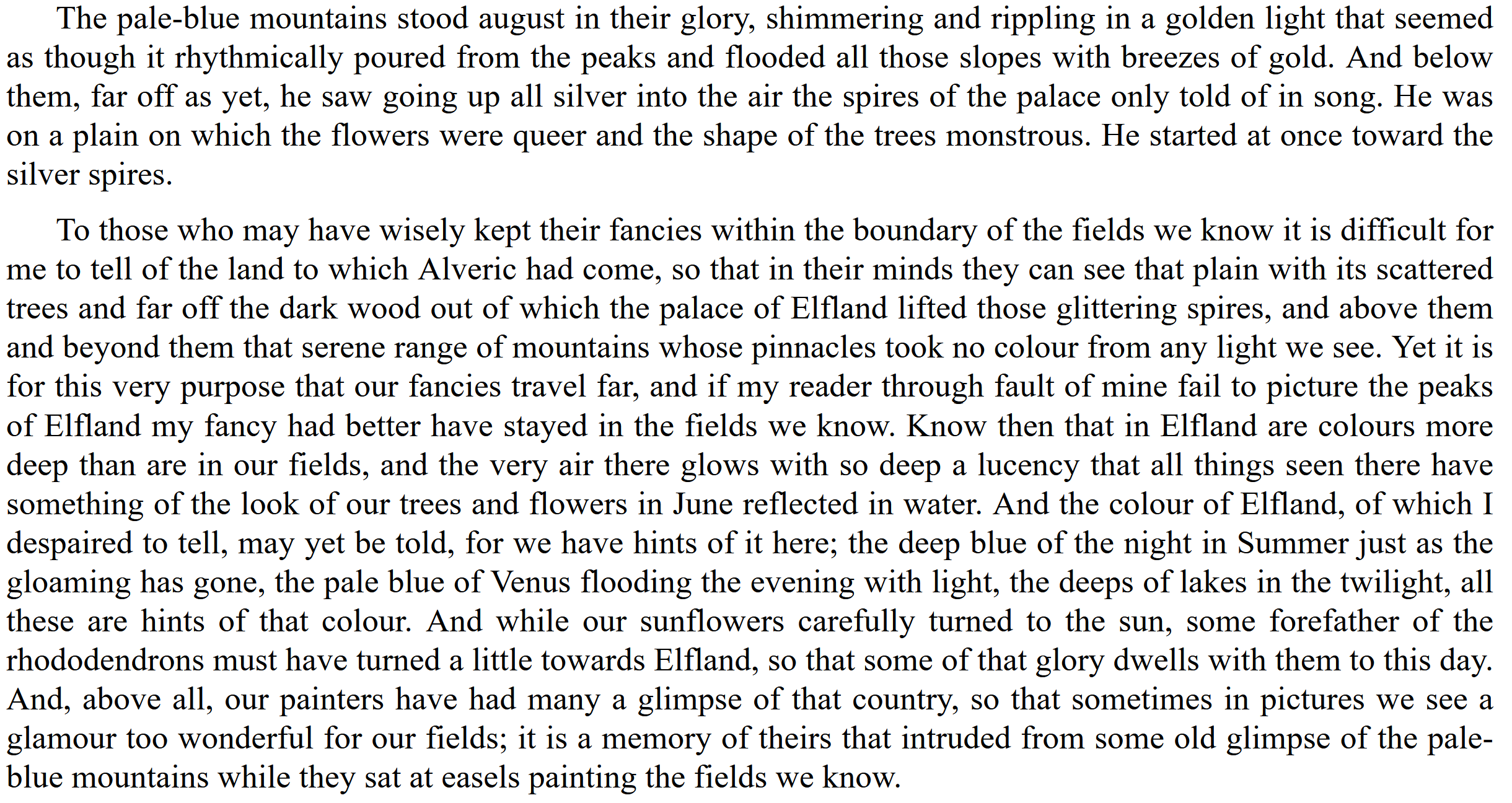
In this strange “Elfland”, the flow of time itself is convoluted. Inspired by some examples from real-world folklore and literature, I had some ideas on how mortals entering Elfland could be effected by their journey. For example, from their own perspective, someone might journey through Elfland for a period of two weeks, only to find that a century has passed once they return to the mortal world. Alternatively, someone might adventure in Elfland for 30 years, becoming a wise and respected lord with an established domain, and when they finally pass back into the “Fields We Know”, they find that it’s only been a few minutes since they’ve left, and they’re still a young peasant boy with nothing to their name.
Entry into Elfland is quite easy, and many have passed into this realm of Faerie unintentionally. It is said that a traveller who journeys deep into an enchanted woodland may inadvertently find themselves entering the realm of the Elves, without passing through any noticeable barrier or border. Other known “gateways” to Elfland include fairy rings, circles of standing stones, and other magic portals.
In regards to the appearance of the Elves themselves, I feel like Poul Anderson says it better than I could, with this excerpt from “Three Hearts & Three Lions”.
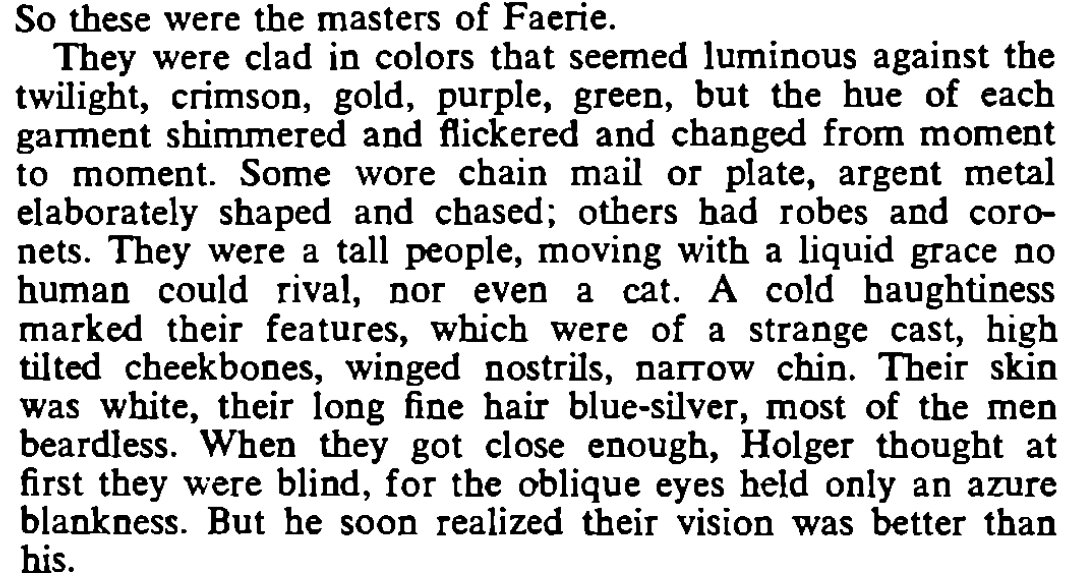
All in all, I hope this post is suitably evocative, and that some aspect of the rules and setting description outlined above provides some inspiration to any referee or player who wishes to incorporate Elves into their game. I have some ideas as to how I might incorporate these rules into my own game, but I’ll leave the details of that for another post.
Until next time, readers.
“Elves are wonderful. They provoke wonder.
Elves are marvellous. They cause marvels.
Elves are fantastic. They create fantasies.
Elves are glamorous. They project glamour.
Elves are enchanting. They weave enchantment.
Elves are terrific. They beget terror.
The thing about words is that meanings can twist just like a snake, and if you want to find snakes look for them behind words that have changed their meaning.
No one ever said elves are nice.
Elves are bad.”
― Terry Pratchett, Lords and Ladies
Now I feel the need to make my own weirdo elves. This provides a lot of great flavor to bake into the campaign world.